
Key Functional Health Areas to Maintain
The Pillars of Longevity Part II - Longevity Medicine Essentials #3

Welcome to the Longevity Medicine Essentials series!
Last time I profiled the main disease areas we prevent in Longevity Medicine.
(Check the bottom of this article for links to the whole series)
In this article I’ll explain:
Why strength, aerobic capacity, sleep, and stress are the key “lifestyle” pillars of Longevity Medicine
The key components within each of the lifestyle pillar (e.g. types of strength)
How we tie each lifestyle pillar to one’s health span goals
The life span evidence we have for each pillar
Why traditional medicine’s approach to these lifestyle pillars falls short
🙏 Thank you for reading this. If this information resonates with you, please subscribe and share it with someone you care about.
Prefer video? Here is a Youtube video covering the content of this article
Longevity Medicine - From Abstract to Actionable
This article introduces the lifestyle health areas - strength, aerobic capacity, sleep, and stress - and introduces the biomarkers we check within them.
These are pillars of longevity because when they are suboptimal quality of life and life expectancy plummet.
Let’s dive in!
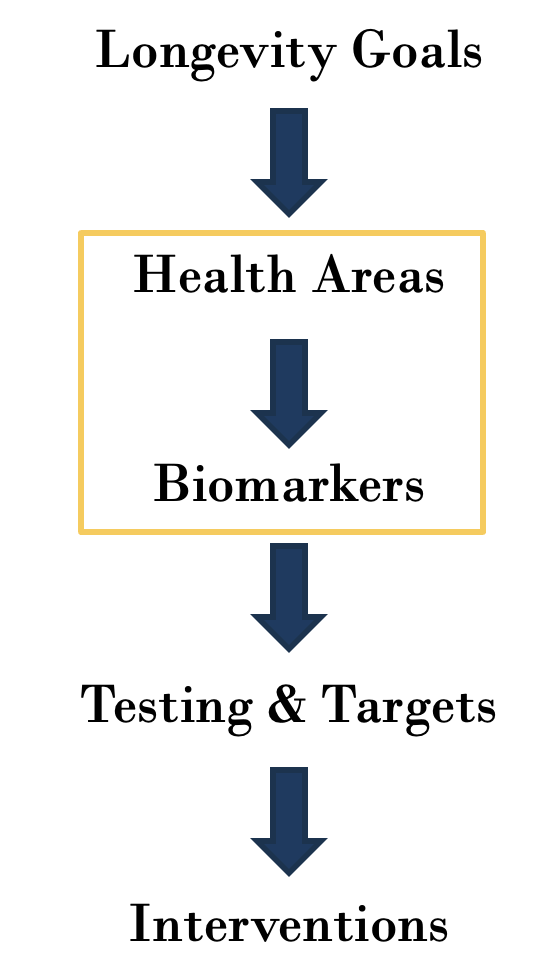
Dr. Pri’s Longevity Goals & Tying Goals to Lifestyle Pillars
“Would you tell me, please, which way I ought to go from here? That depends a good deal on where you want to get to” - From Alice in Wonderland by Lewis Carroll
The lifestyle pillars are key for ensuring you can live the life you desire as you age. It’s true optimal sleep, stress, strength and aerobic capacity will provide longer life, but none of that matters if you aren’t enjoying your time.
So it’s critical that you define what YOU desire in your last decade through the Longevity goals. If your dream lifestyle requires a lot of strength, then we’d better focus there. If not, then perhaps stress and sleep will be key.
Longevity medicine defines the metrics, but you set the target.
To help demonstrate this, here are my longevity goals:
I’d like to live until my 110s (I know, ambitious, but I’m not trying to live forever!)
Activities I’d like to be able to do at that age:
Travel on an airplane to awesome destinations
Play with and keep up with my grandchildren
Be able to jog on the beach and go on small hikes
Have intellectual conversations and create content
My dream vacation to Santorini, Greece in my marginal decade

I often dream of a trip with my wife to Santorini at the spry age of 110.
As a longevity nerd, I imagine the aerobic capacity and strength I’ll need to do it right - putting our bags in the overhead section of the plane, going on an easy jog on the beach, and getting up and down all of those picturesque staircases. I’d also want to be able to sleep and be stress free when out there!
Let’s explore what metrics I’ll have to consider to get there.
Strength
Key components
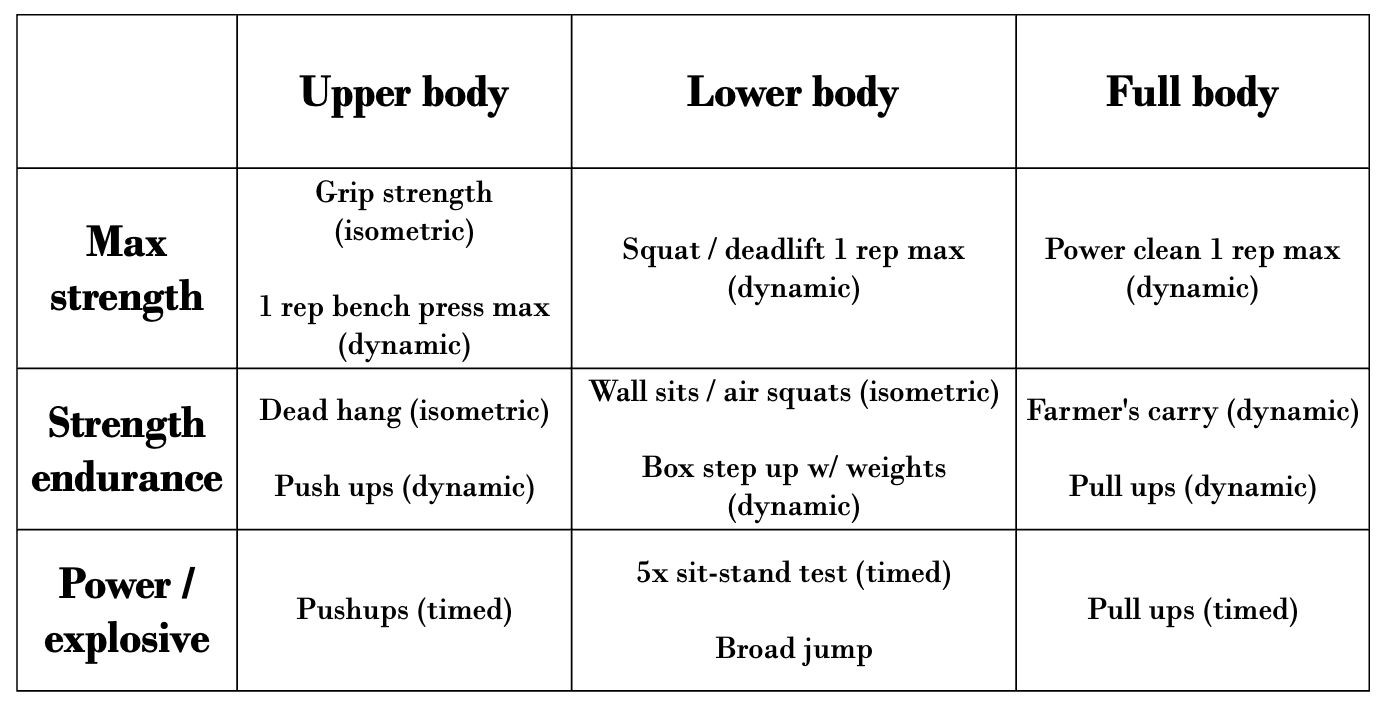
We evaluate strength across 2 axes resulting in 9 categories:
Body area - full, upper, and lower
Strength type - endurance, max, and power / explosive
Here’s a diagram I share with my patients with exercises to measure each category, which we’ll train against.
Strength’s impact on health span
Let’s apply these categories to my dream Santorini vacation.
I’ll need upper, lower, and full body strength to manage luggage - max strength to lift bags in the plane and plenty of endurance to carry them around. I probably won’t need much explosive strength unless I get into a race on the beach (unlikely).
Generally people will need a minimum amount of max strength and a solid amount of endurance across their whole body to continue the activities they enjoy in life, with power mattering more for injury prevention or for those with speed related goals.
You might wonder - is it even possible for a 110 year old to lift up a 30 pound bag?
Well an 80 year old man just completed a 135 mile ultramarathon! Who’s to say you can’t lift a few bags in your 90s?
The issue is prior generations didn’t try to train into their 80s, 90s, and 100s, so we don’t know what is possible. I believe a lot of us can get there, so dare to dream!
Strength’s impact on lifespan
We have some good data linking strength to lifespan:
Training 40-100 min / week can lead to a 10-17% lower risk of all-cause mortality
Every 10kg drop in grip strength leads to a 30% increase in all-cause mortality
Inability to carry 10 lb in each hand for 1 min leads to a significant mortality risk
Strength >>> Muscle Mass
The zeitgeist is that you should do anything humanly possible to add muscle mass before turning 60 or you are doomed Longevity-wise. So these days young folks are eating insane amounts of protein to add mass in anticipation of the decline.
This dietary approach deprioritizes other important factors (e.g. fiber), can be costly, and is not pleasant. Some people are even resorting to anabolic steroids!
This idea is not supported by science - data shows strength, not muscle mass, leads to longer life, and intuitively strength is more relevant for specific activities. Mass is correlated with strength, but they aren’t the same.
In fact, in the blue zones (areas with the most people over 100) like Okinawa, Japan people were not bulky, but they did maintain strength
This is a topic I’ll be writing more about in the future, but I wanted to emphasize that having the strength to live the life how you want is the focus.
Aerobic Capacity
Key components
The components of aerobic fitness are similar to strength: Max output (VO2 max), endurance (Zone 2 output), and explosiveness (VO2 power).
Formal definitions:
VO2 max = the max rate at which your body can take in and utilize oxygen. This defines your max aerobic output, but you won’t be able to stay here for long
Zone 2 output = your sustainable output, basically right at the threshold of lactic acid creation. Given enough food, you can stay at this level endlessly
VO2 power = How quickly you can go from rest to VO2 max
Impact on health span
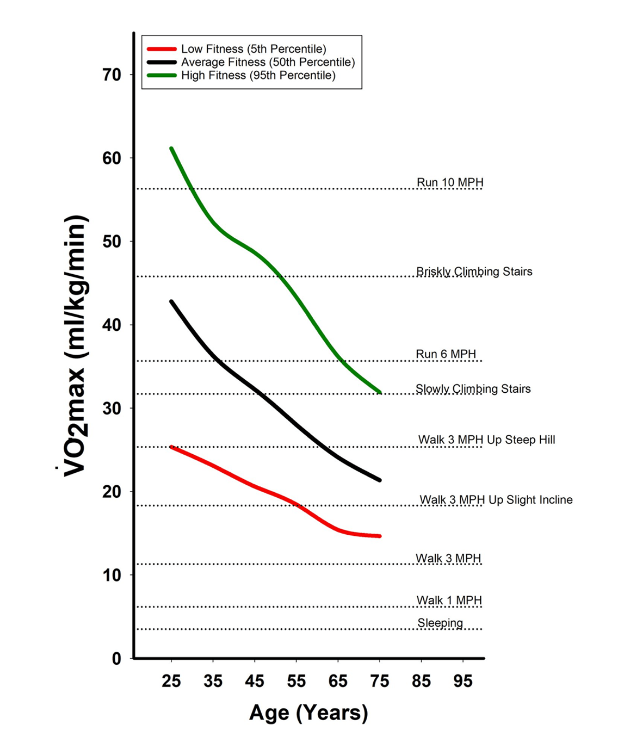
This is one of my favorite charts because it clearly ties a measurable, modifiable metric (VO2 max) to longevity goals. Bookmark it!
Applying this to my Santorini dream - I’d love to jog on the beach at 6 miles per hour (10 min mile), so I’ll need to hold a VO2 of roughly 35 ml / kg / min. That is my zone 2 target since I want to maintain that speed with ease. Getting up those famed Santorini stairs briskly defines my peak, giving me a VO2 max target 47.
The chart above suggests VO2 max will drop off sharply after 50 years. But how much were those study participants training? Where would they have been if they focused on maintaining VO2 max as they aged? That won’t be our fate!
I am confident the rise of longevity medicine will result in people training late into life and redefining what is possible, or even normal, in our 80s and beyond.
Impact on lifespan
We actually have excellent data on aerobic fitness and lifespan.
Sleep
Key components
There are SO many sleep metrics out there (including vague “scores” from tracking devices). We like to keep it simple and broadly group into sleep duration and quality.
Sleep duration is self explanatory. It’s better to measure this objectively via tracking devices, but simply noting the time you got into bed and got up works great.
Sleep quality is where you can really go down the rabbit hole. We’ve simply with:
How rested you feel in the AM (from 1 to 10, 10 being perfectly rested)
If you have energy throughout the day
Impact on health span
Sleep’s link to health span is the most intuitive of the lifestyle pillars. We’ve all felt fatigue, brain fog, irritability and depression when we don’t sleep enough - so I won’t belabor the point.
Sometimes you sleep for long enough, but still don’t feel great. At that point it makes sense to dive into the various sleep quality metrics (which I’ll detail in future articles).
One of the best things about sleep is you can almost always tweak your habits to see immediate improvements.
By the way, when I’m in Santorini I’m confident I will sleep like a baby because of decades of excellent sleep hygiene and perfecting my jet lag protocol.
Impact on lifespan
Unsurprisingly, there is a lot of great data showing optimal sleep improves lifespan:
Those who sleep an “optimal” amount (7-8 hrs for most people) live 10-40% longer
Consistent sleeping and waking times results in 20-50% lower all-cause mortality
Suboptimal sleep duration increases Alzheimer’s dementia risk
Stress
Key components
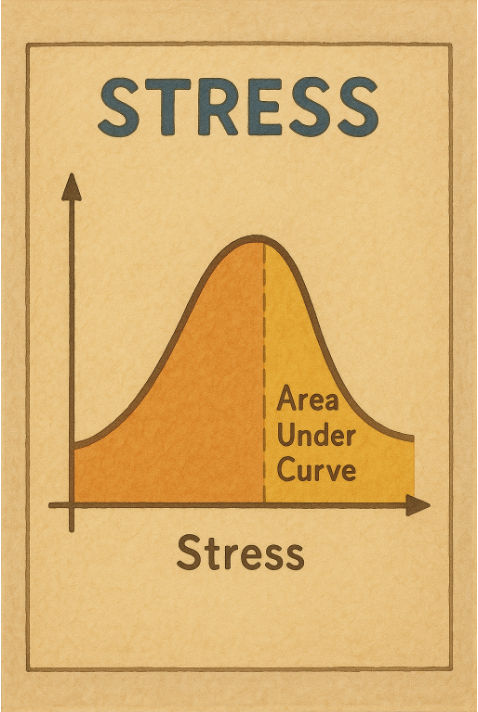
In our practice we segment stress into acute stress and chronic. The image above demonstrates how we think about these separately:
Acute stress - minimize the number of peaks, peak height, and duration
Chronic stress - minimize the baseline height and area under the curve
How do we even measure stress?
Currently we rely on subjective reports of stress, but in our practice we are moving towards objective data to improve identification and management of stress.
Stress is an activation of your sympathetic nervous system (fight or flight) over the parasympathetic (rest and digest). Lower heart-rate variability (HRV) and higher baseline blood glucose indicates high sympathetic activity, so we look to these though it’s early days and still difficult to interpret.
Impact on health span
Most of us are familiar with the quality of life impact of chronic stress. Anxiety and depression are prominent, and worse yet sleep suffers compounding the issue. If you’re like me, you also will start gaining fat!
Acute stress isn’t much better, often causing relationship harm and degrading self esteem.
Tying it back to my Longevity Goals - I didn’t fly across the Atlantic to be stressed in Santorini! Decades of practicing stress management techniques will ensure I quickly squash acute stressors and keep baseline levels low.
Impact on lifespan
We only have a couple imperfect studies tying stress to life span:
Perceived high stress increases all-cause mortality from 20-30%
Low heart rate variability is correlated with 56% higher all-cause mortality
How Traditional Medicine Views Quality of Life
It’s useful to contrast the Longevity Medicine approach to quality of life / lifestyle with trad med because it shows why we can’t leave this up to the legacy system.
In trad med won’t get any true lifestyle assessment until you have a “geriatric assessment” which typically occurs once you are over 65 or just appear frail.
These assessments are intended to determine if you can live alone or if you need help, not to keep you happy. It’s primarily the realm of social work.
The main assessment is Activities of Daily Living (ADLs), which are if you can take care of yourself - bathing, dressing, feeding yourself, moving in your home, etc.
Then there are Instrumental ADLs (IADLs), a bit more advanced, but still a low bar - paying bills, laundry, getting to appointments, preparing meals, shopping, etc.
From the trad med standpoint, if you can meet your ADLs and IADLs then you are good to go. Don’t worry about taking hikes or going to Santorini this is good enough!
Not too satisfying, right?
Up next - Core Cardiac Biomarkers
The next article will cover the core biomarkers we evaluate for cardiovascular disease (CVD) prevention.
It might be a long one because there are many risk factors for CVD, but it will be worth it as you’ll walk away knowing of what you need to check to avoid the #1 cause of death and disability worldwide.
Thank you for reading and make sure you subscribe to get the newest info directly to your inbox!
The Complete Longevity Medicine Essentials Series